
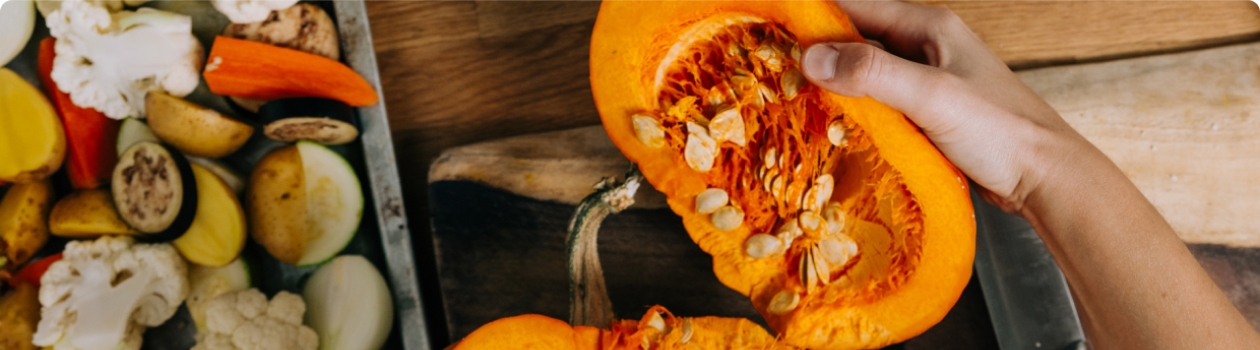
When the leaves start to change, the temperatures drop, and the stars appear earlier in the sky, it’s a sign that fall is back.
Cool weather is a sign of comfort, with its warming dishes and thick sweaters, but it can also be a reminder to take care of yourself when the change of season arrives. Energy and sleep can be impacted by the shortening of the days. And in such a context, a well-thought-out diet can be our best ally by getting in tune with our biological clock.
A Happy Microbiota
It is often said that good health depends on the gut, and research is increasingly focused on its role beyond digestion. The gut is sometimes referred to as the “second brain” because it contains 200 to 500 million neurons and communicates continuously with the brain through the vagus nerve. It is also home to billions of microorganisms, better known as the gut microbiota, which are involved in many of the body’s functions.
The change of seasons, the reduction in hours of sunlight and the time change can, on the other hand, have a direct influence on mood. In this context, taking care of your gut by eating foods that are favourable to it is one of the actions that contribute to our general well-being, alongside sufficient exposure to light, regular physical activity and quality sleep.
Fermented Foods
Fermented foods themselves contain billions of live good bacteria – some of which have famous probiotic properties, which send reinforcements to the intestine while feeding the bacteria already present.
- Kefir
Kefir is a very versatile food: this fermented, slightly fizzy milk drink contains yeast and bacteria. It is drunk like milk, but it can be used in all kinds of ways.
It can be added to your cereal, smoothie, oatmeal or chia pudding. As long as you don’t cook the kefir, it keeps its bacteria alive. It’s a very simple way to make our recipes more nutritious!
- Homemade Kombucha
- Cabbage
- Tasty Soups
- Nutritious Snacks
Why not take advantage of this homebody season to embark on more ambitious projects, such as fermenting your own kombucha? This fermented black or green tea drink has gained popularity in recent years, and it’s for good reason: its tangy taste and fizz add a festive aspect, while containing live bacteria and yeast from fermentation.
Cabbage ferments in a variety of ways; there’s the famous sauerkraut, as well as the spicier Korean kimchi. They both contain billions of good bacteria, in addition to being high in fibre.
Why not make your own kimchi? You can then use it as a side dish or as a condiment in some favourite recipes, like these burgers.
Sauerkraut is also delicious in sandwiches, as an accompaniment to meats, and even in a salad. Note that if it is cooked, the bacteria will be destroyed by the heat. You can then choose a store-bought sauerkraut that is not pasteurized.
Eating Prebiotics
The role of prebiotics is to nourish the gut microbiota: these are parts of food that are not digested and that will ferment in the intestine to feed the good bacteria already present. They are found in a host of foods: legumes, fruits, nuts, seeds and cereals.
Prebiotics are found in garlic, onions, Jerusalem artichokes, leeks and shallots. What good news for the season of soups of all kinds, such as this creamy cauliflower and leek one! A comforting and nourishing soup is guaranteed.
Oats, whole wheat, barley, pistachios and cashews are all foods rich in prebiotics. They can easily be incorporated into our favourite apple or pumpkin muffin recipes, perfect for fall!
Snacks for Sleep
For a small snack at the end of the day, you can bet on foods that provide tryptophan or melatonin, such as nuts and certain fruits. These may contribute to the mechanisms associated with sleep. Tryptophan contributes to the production of serotonin and melatonin, both of which play a role in sleep and mood.
Studies have observed an increase in melatonin after eating certain foods, while a diet rich in melatonin could improve sleep quality. Although data remains limited for the moment, it may be interesting to eat well, while promoting sleep regulation.
A Good Ripe Fruit
Eating bananas, tart cherries, kiwis, grapes and pineapple has been associated with an increase in blood melatonin concentration, according to recent studies. Strawberries are also rich in melatonin, although these amounts are modest compared to the body’s physiological needs. These tasty fruits are great as a snack or dessert, so don’t hesitate to help yourself!
Nuts
Pistachios are among the nuts richest in melatonin, as are walnuts and almonds. You can eat a small amount of them or add them to your favourite muffins and breads, for example.
In any case, it is important to listen to your body and make sure that a varied and nutrient-rich diet supports it for the change of seasons. Enjoy your meal!
Sources:
https://cdhf.ca/en/prebiotics-vs-dietary-fibre/
Fujihira K, Takahashi M, Wang C and Hayashi N (2023) Factors explaining seasonal variation in energy intake: a review. Front. Nutr. 10:1192223. doi: 10.3389/fnut.2023.1192223
Pereira GA, Gomes Domingos AL, Aguiar AS. Relationship between food consumption and improvements in circulating melatonin in humans: an integrative review. Crit Rev Food Sci Nutr. 2022; 62(3):670-678. DOI: 10.1080/10408398.2020.1825924. Epub 2020 Oct 1. PMID: 33000641.
Meng X, Li Y, Li S, Zhou Y, Gan RY, Xu DP, Li HB. Dietary Sources and Bioactivities of Melatonin. Nutrients. 2017 Apr 7; 9(4):367. DOI: 10.3390/NU9040367. PMID: 28387721; PMCID: PMC5409706.
Oladi E, Mohamadi M, Shamspur T, Mostafavi A. Spectrofluorimetric determination of melatonin in kernels of four different Pistacia varieties after ultrasound-assisted solid-liquid extraction. Spectrochim Acta A mol Biomol Spectrosc. 2014 Nov 11;132:326-9. doi: 10.1016/j.saa.2014.05.010. Epub 2014 May 16. PMID: 24878439.
Nisar T, Fuller A, Gyawali P, Bird S. Effectiveness of Melatonin-Containing Foods on Promoting Sleep: A Scoping Review. [eos]Food Sci Nutr. [eos]2026 Apr 27; [eos]14(5):e71823. [eos]doi: 10.1002/fsn3.71823. [eos]PMID: 42058225; [eos]PMCID: PMC13121932.

